Yorkshire Sport Climbing
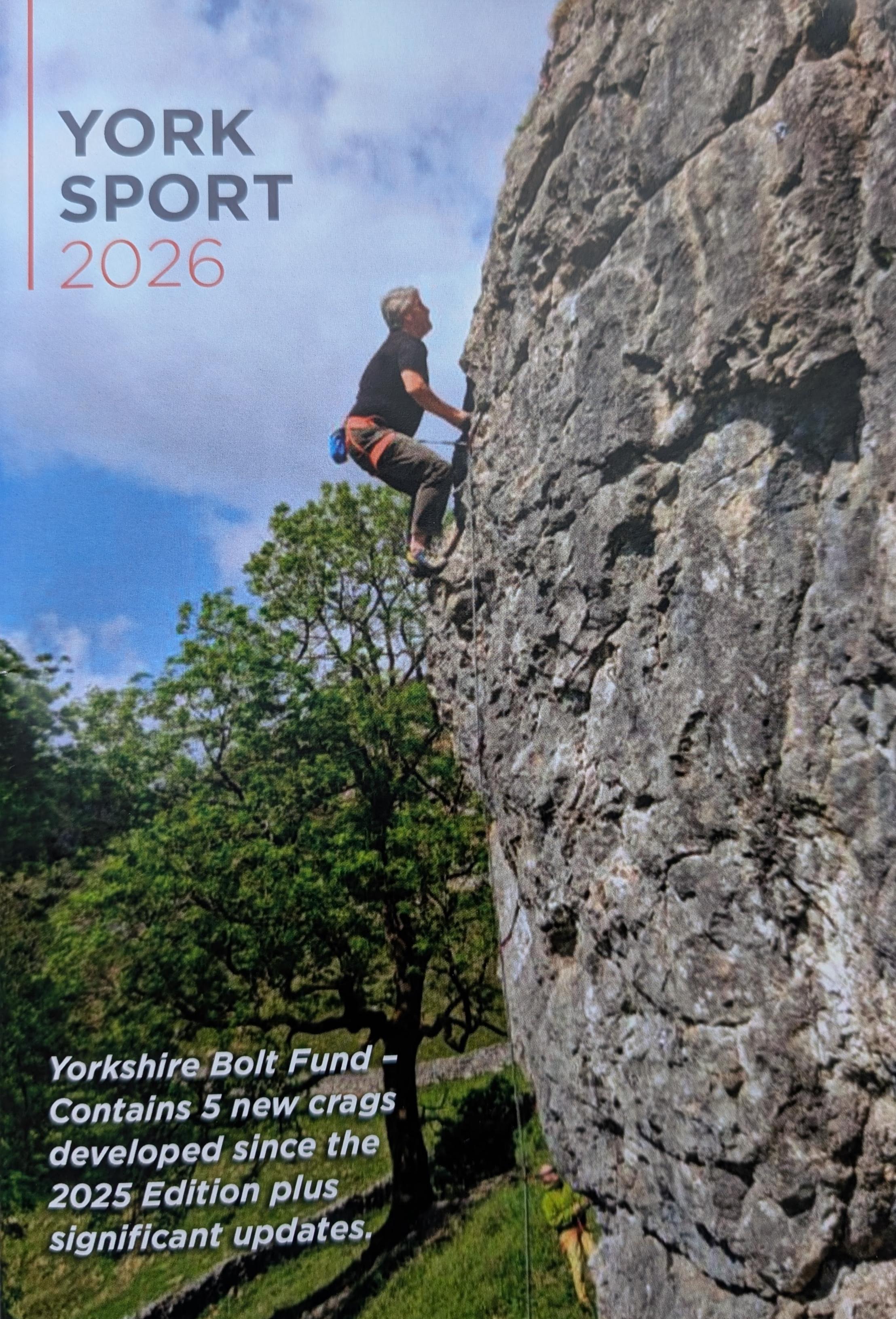
Most of the newly developed ‘steady’ sport routes in Yorkshire are documented in the recently updated York Sport 2025. However, the pace of development means that several new crags are included in the newly published York Sport 2026.
Developments of this kind plus replacement and new lines on the major crags are supported by the Yorkshire Bolt Fund. Please feel free to contribute if you wish.
Contributions can be made via Paypal (just search Paypal Yorkshire Bolt Fund) or better still, as they take a cut, by bank transfer to the bolt fund account at Sort Code 53-70-00 Account Number 24433764. If you make a contribution of around £15 and then email Dave Musgrove at davemusgrove7b@gmail.com he will post a copy to you.
Also available at some walls and shops inc Needlesport, Inglesport, Big Depot.

PLEASE NOTE: Due to the nature of mountain limestone the developing areas may have, or be close to, some loose rock (usually noted in the script) and may require the necessary experience and be approached with the care due to such locations. The BMC recognises that climbing and mountaineering are activities with a danger of personal injury or death. Participants in these activities should be aware of and accept these risks and be responsible for their own actions.,All fixed gear has been placed with regard to making these climbs as sport routes. However, the rock is mountain limestone and it is for the individual to assess the security they provide.
Development since publication can be downloaded below:
Replacement of fixed gear is a costly and time-consuming exercise so please lower or top-rope off your own quick draws. By doing this you will extend the life of the equipment considerably.
Donations to the Yorkshire Bolt Fund can be made using the link below
Yorks Sport Routes – FA dates and possible age of the bolts.
Bolts were common on aid routes in Yorkshire from the 1950s and 1960s. During the late 1970s and 1980s the use of bolt runners and belays, for both trad and sport routes, became increasingly common. A lack of understanding about corrosion and the absence of bolts for sale in climbing shops meant the most economical options were often used. With the passing of time many of these bolts have corroded, sometimes to a dangerous state, and a couple of near misses identified the need for funding to make better quality materials available for replacement and new route development.
The Yorkshire Bolt Fund was formed as a vehicle to share the cost amongst the wider climbing community. Also, around this time an initiative by the BMC oversaw the recommending of metals, fixings, resins and systems.
Since this time sport climbing has developed apace and so the number of bolts has increased exponentially. There are close 2400 sport climbs on Yorkshire limestone and more than 10 times this number of bolts.
With the availability of funds (and also at personal cost), the great majority of the 1980s bolts have been replaced, especially on the most popular routes on the major crags. The tens of thousands of hours this has taken has been shared by many climbers volunteering their time and it is certain that this has made climbing here significantly safer and probably saved lives.
However, even high quality placements do not remain secure for ever and it seems sensible to identify those that have been in-situ for some time. A problem arises in that the first ascent information only gives us the date of the first bolts and not any subsequently added or replaced. There may even have been bolts in-situ from earlier activity.
Nevertheless, this spreadsheet may be a useful tool to begin updating the records and to indicate routes to which you aspire where it would be beneficial to check for any sign of deterioration of the bolts. Unfortunately that doesn’t guarantee their security and it may be that you should consider replacing the gear if there is any doubt. The information is just a start so please do not assume that a letter y in the replacement column means that all have been replaced and, of course, a letter n is not indicative of likely problems, especially for recent bolts.

